From woodblock to bodysuit
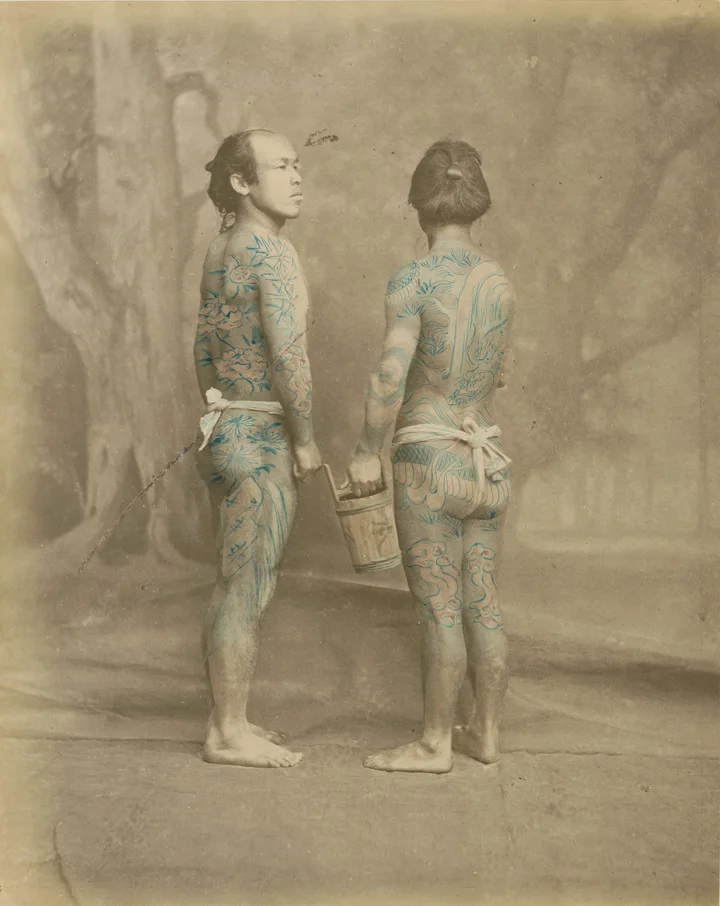

Some of the most influential tattooed bodies in Japanese art were printed on paper.
In the late 1820s, printmaker Utagawa Kuniyoshi depicted tattooed heroes in his series based on the Chinese novel Water Margin, known in Japan as Suikoden. The Museum of Fine Arts, Boston describes an oral tradition among tattooers that connects the prints with a fashion for large pictorial tattoos. That is a story about influence, not a claim that one printmaker invented Japanese tattooing.
Read the body as a composition
In a large-scale Japanese tattoo, the background can help tie the shoulders, back, and limbs together. The interesting question is not simply what a dragon “means.” It is how the artist uses the dragon, the background, and the open skin to make a composition that reads as the person moves. Tebori is a hand technique, not a synonym for every Japanese tattoo.
People worth knowing
Horiyoshi III is a tattoo master associated with large-scale Japanese work. The Pitt Rivers Museum describes a lineage that has used both hand needles and electric tools. Horitaka, Takahiro Kitamura, is a tattooer and author whose work on Japanese tattoo traditions is profiled by the Japanese American National Museum. Kuniyoshi belongs in this story as a printmaker, not as a tattooer.
Japanese tattooing has had multiple meanings, including devotion, fashion, punishment, and stigma. Reducing the whole tradition to organized crime wipes out much of that history.