Batok in Kalinga
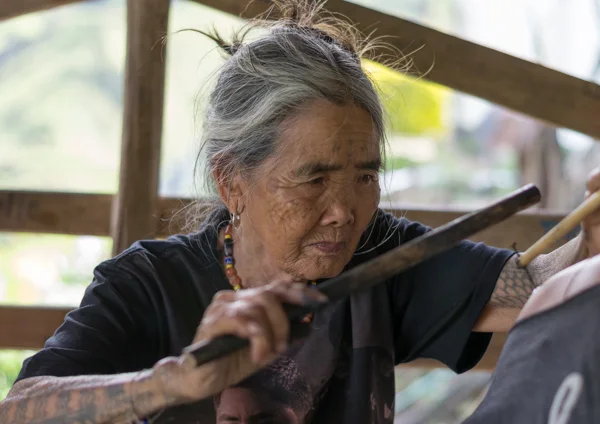

The story begins with a community, not a tourist itinerary.
The National Museum of the Philippines documents tattooing among multiple peoples in the northern Philippines. Here the focus is Butbut Kalinga batok, also written whatok in accounts about the tradition. Accounts of Apo Whang-od describe a thorn attached to a handle and tapped by hand. Calling it “stick and poke” misses that motion and the tradition behind it.
Apo Whang-od Oggay
Whang-od is a mambabatok from Buscalan, Kalinga. In 2018 the Philippine National Commission for Culture and the Arts honored her with the Dangal ng Haraya for her contribution to preserving Butbut Kalinga tattooing. Her recognition is a useful starting point, not a reason to collapse every Cordillera tattoo practice into a single artist or vocabulary.
Meanings change with community, time, and the person wearing the marks. A motif visible in a museum or on social media is not automatically an invitation to reproduce it. Look for accounts that name the community and maker rather than a chart that promises to decode every design.